

Optical mechanisms
Understand how signals form through sensing and demodulation, and how system characteristics affect observations.
PHYSICS-INFORMED AI + FIBER SENSING
Acquire field information through distributed fiber sensing and integrate optical mechanisms, propagation principles and engineering constraints into model development, exploring the path from signal analysis to event understanding.
01 / FROM FIBER TO SENSING
Fiber deployed along infrastructure can do more than carry information: it can reveal changes in the physical world. Distributed fiber sensing captures signals along the route; algorithms and AI models turn those disturbances into event insights that can be located and investigated.
02 / HOW IT WORKS
In distributed acoustic sensing (DAS), an interrogator launches optical pulses into a single-mode fiber and reads the weak backscattered light. Vibrations or strain affect the optical signal. Analysing these changes and their return timing reveals the location and temporal features of disturbances along the route.
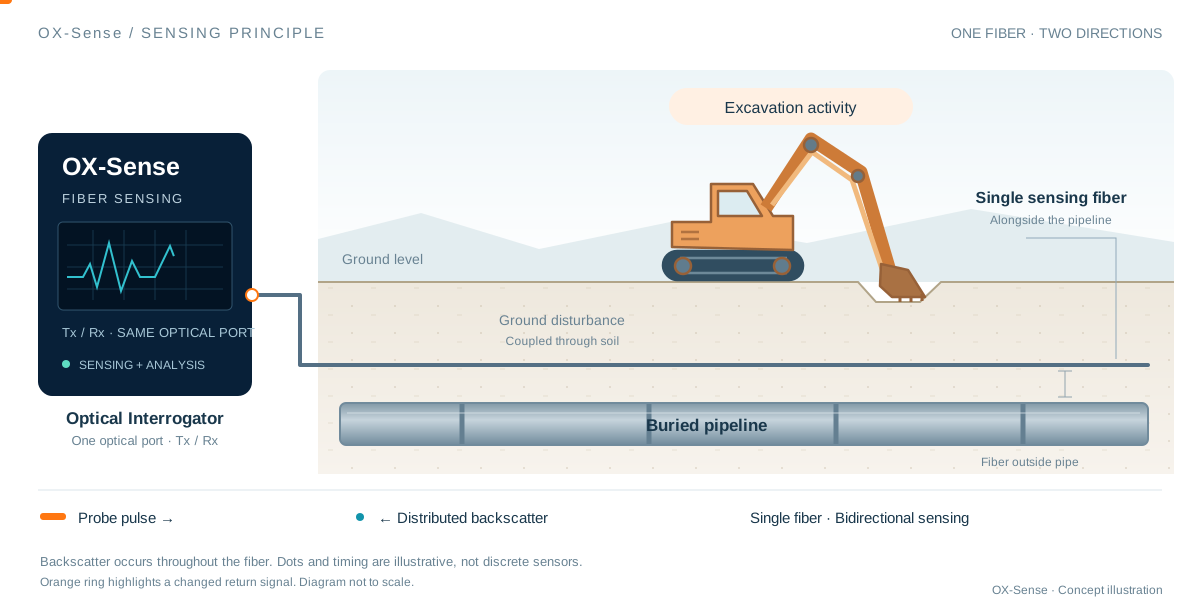
An interrogator connects to the fiber and launches probe light.
Read backscattered light to resolve changes along the route.
Signal processing and model analysis provide insights for field investigation.
Sensing coverage and signal quality depend on the sensing method, installation, coupling and environmental conditions.
03 / PHYSICS × DATA-DRIVEN LEARNING
Similar events can produce different signals under different installation and environmental conditions. OX-SENSE is combining physical knowledge and data-driven learning, incorporating optical sensing processes, propagation characteristics and engineering conditions into model development for a better-grounded understanding of events in complex settings.
Understand how signals form through sensing and demodulation, and how system characteristics affect observations.
Study the temporal, spatial and frequency characteristics of disturbances to provide physical grounding for event representation and model analysis.
Consider installation, site coupling, background noise and operating conditions to connect research with practical application challenges.
04 / TECHNOLOGY HIGHLIGHTS
Connect the sensing capabilities of fiber with algorithms, models and engineering experience.

Evaluate existing fiber for sensing against available cores, installation and coupling conditions.

Capture spatially distributed observations to understand where and how changes occur.

Combine signal features and application context to study event classification and background interference.

Incorporate optical mechanisms, propagation principles and engineering constraints into model development and validation.
05 / BUILT AROUND FIELD CHALLENGES
Each method must be assessed against specific datasets, test conditions and field validation.
Study how to distinguish background disturbances from target event features, improving the discernibility of useful information.
Explore how physical knowledge and data-driven learning can work together when event samples are limited.
Study model performance as field conditions change, using cross-scenario validation to assess applicability.
06 / MONITORING AND COLLABORATION
From signals and event locations to investigation records, a monitoring platform gives analysis its field context. OX-SENSE is developing data, models and the platform together around event location, signal review and human investigation. Integration with existing operations systems is assessed against project needs and interface requirements.
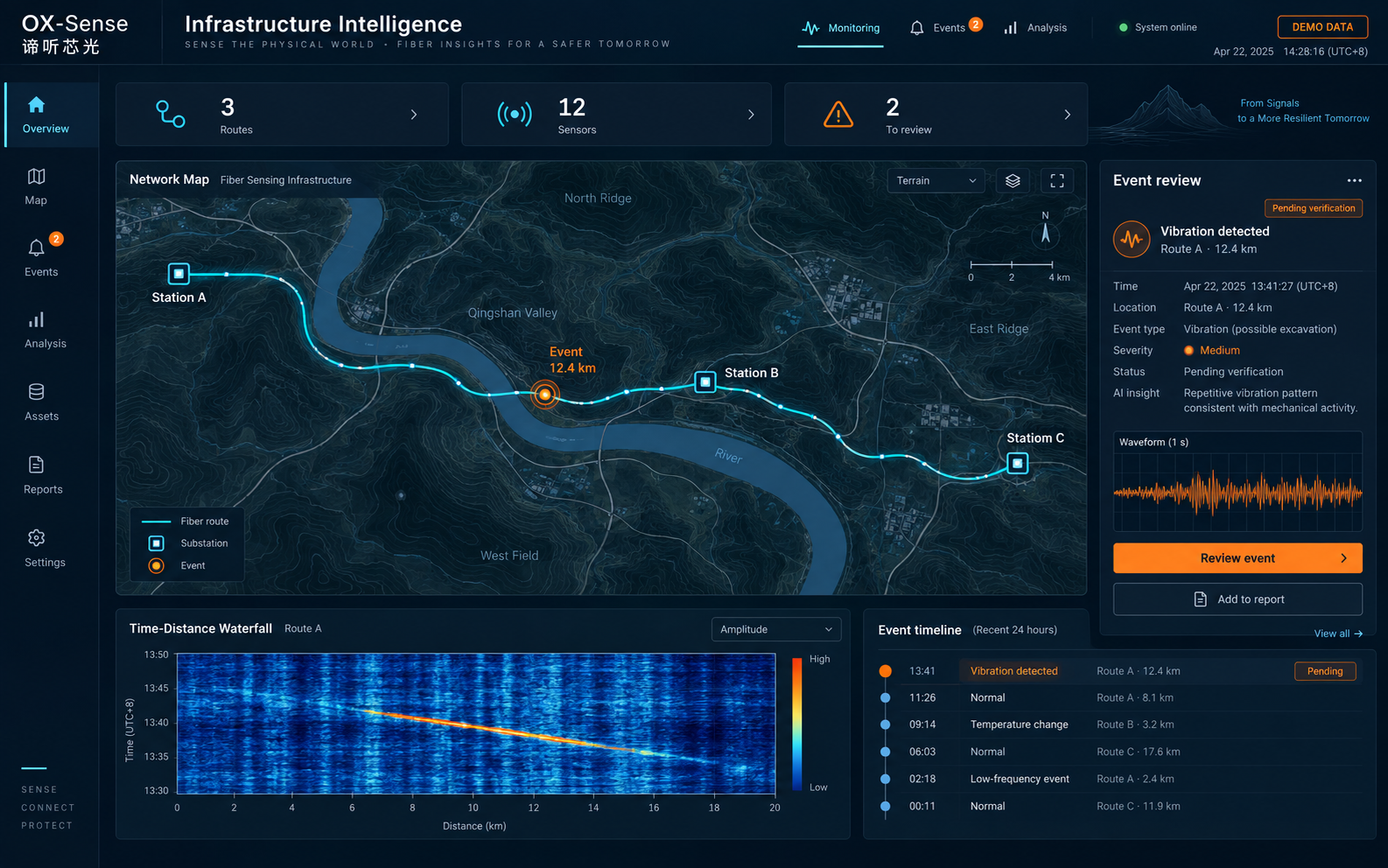
Signals along the route
Algorithm and model outputs
Locations and event insights
Human judgement and coordinated response
07 / RESEARCH FOUNDATIONS
The following public research involves our founder and collaborating teams. Product capabilities depend on the specific solution and its validation results.
Review · PhotoniX · 2025 A framework for sensing and intelligent analysis, covering work by multiple teams in the field.
Read the research ↗Conference paper · OFC 2025 Explores neural networks for spatial-resolution research. Link to the institutional record and abstract.
Read the research ↗Institutional research report · SUSTech · 2026 Introduces research into integrating sensing systems with AI agents.
Read the research ↗FEEL THE WORLD
Discuss your assets, target events and field conditions to explore sensing methods, model adaptation and a validation pathway.
Discuss technical needs