

Train activity
Observe passage locations and timing, using route mapping to analyse moving signatures.
SMART RAIL / PHYSICAL AI
Connect trackside fiber, physical AI and operational context to observe train activity, investigate wheel–rail signatures and review events along the route.
01 / ROUTE AWARENESS
Train-induced vibrations couple through track, ground and cable into distributed signals. Fiber sensing places these observations on shared spatial and temporal coordinates, complementing existing monitoring.
Observe passage locations and timing, using route mapping to analyse moving signatures.
Extract changes in wheel–rail responses and vibration patterns that merit review.
Associate external activity and environmental disturbances with sections for field investigation.
02 / APPLICATIONS
Define observations around specific use cases and interpret vibration signals alongside operational context.
OX-Sense concepts · Waveforms and visual effects are illustrative, not measured data. Longitudinal soil cutaways reveal cable routes parallel to the railway. Actual direct-buried installations are backfilled and compacted, with no exposed cable; depth and separation are defined by site design.
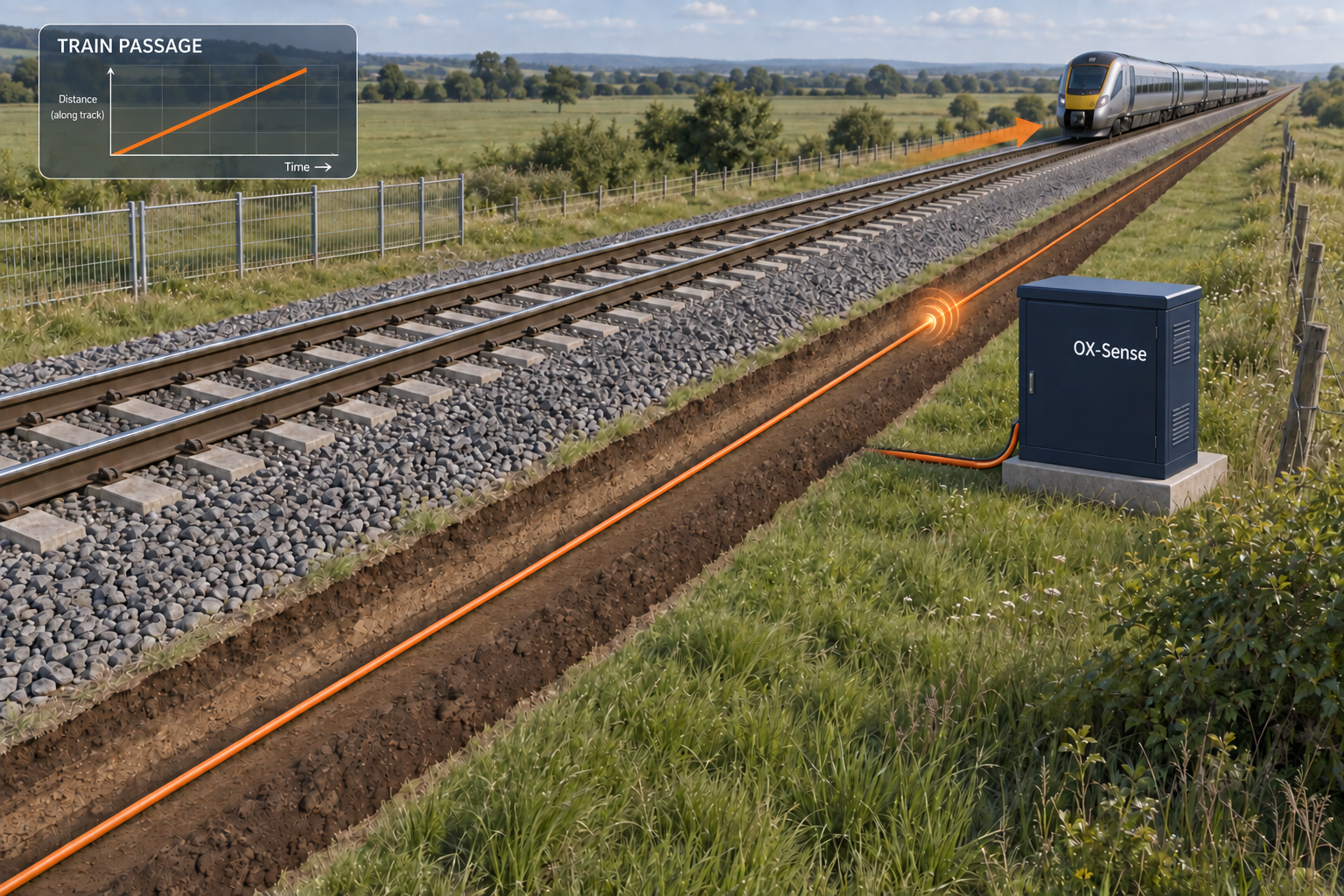
Moving signatures in distance–time records support investigation of train passage, journey times and speed estimates after route calibration, with checks against timetables or existing location data.
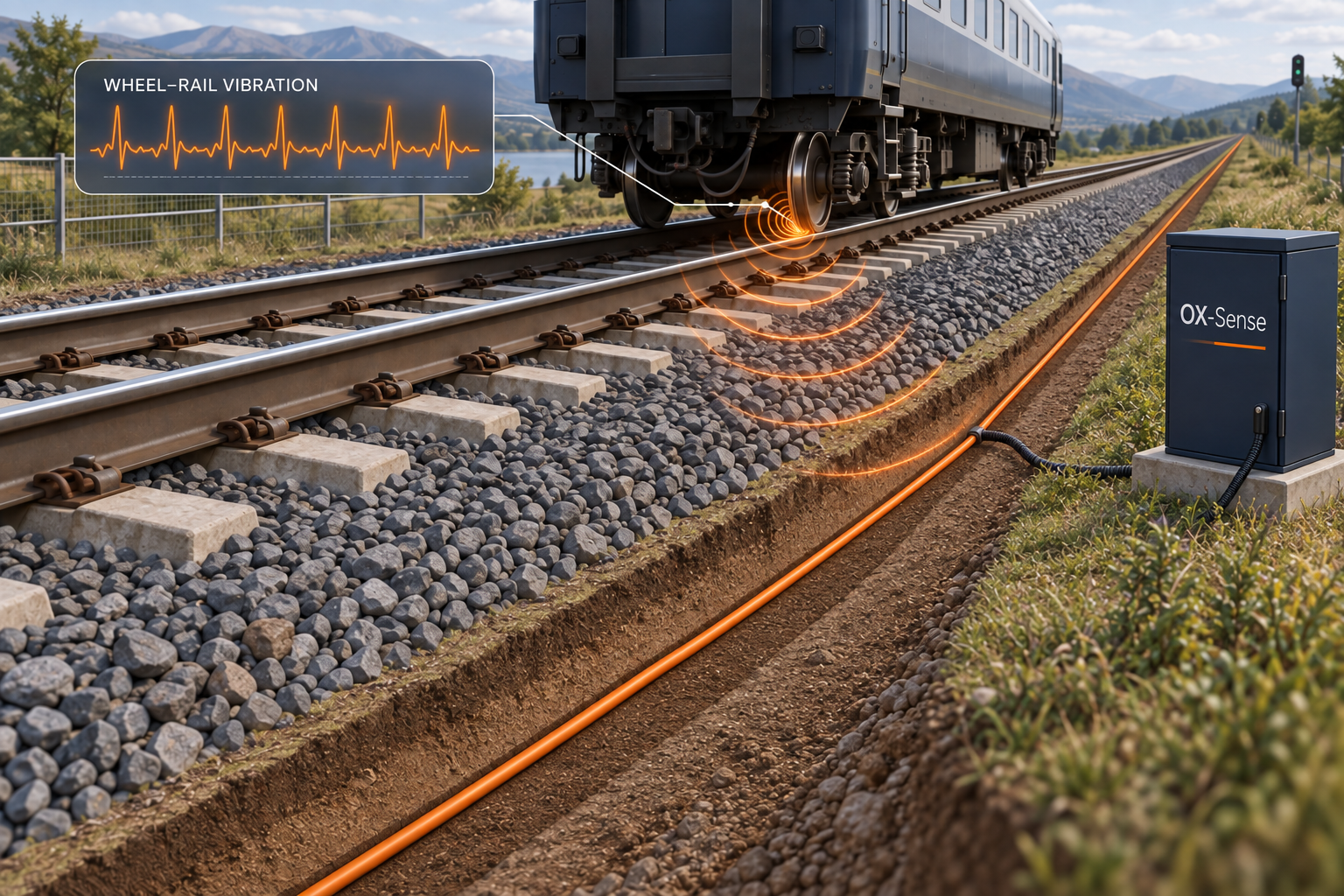
Study repeated impacts, local responses and spectral changes as candidate wheel–rail anomaly features. Build baselines for train type, speed and load, then validate against specialist inspections.
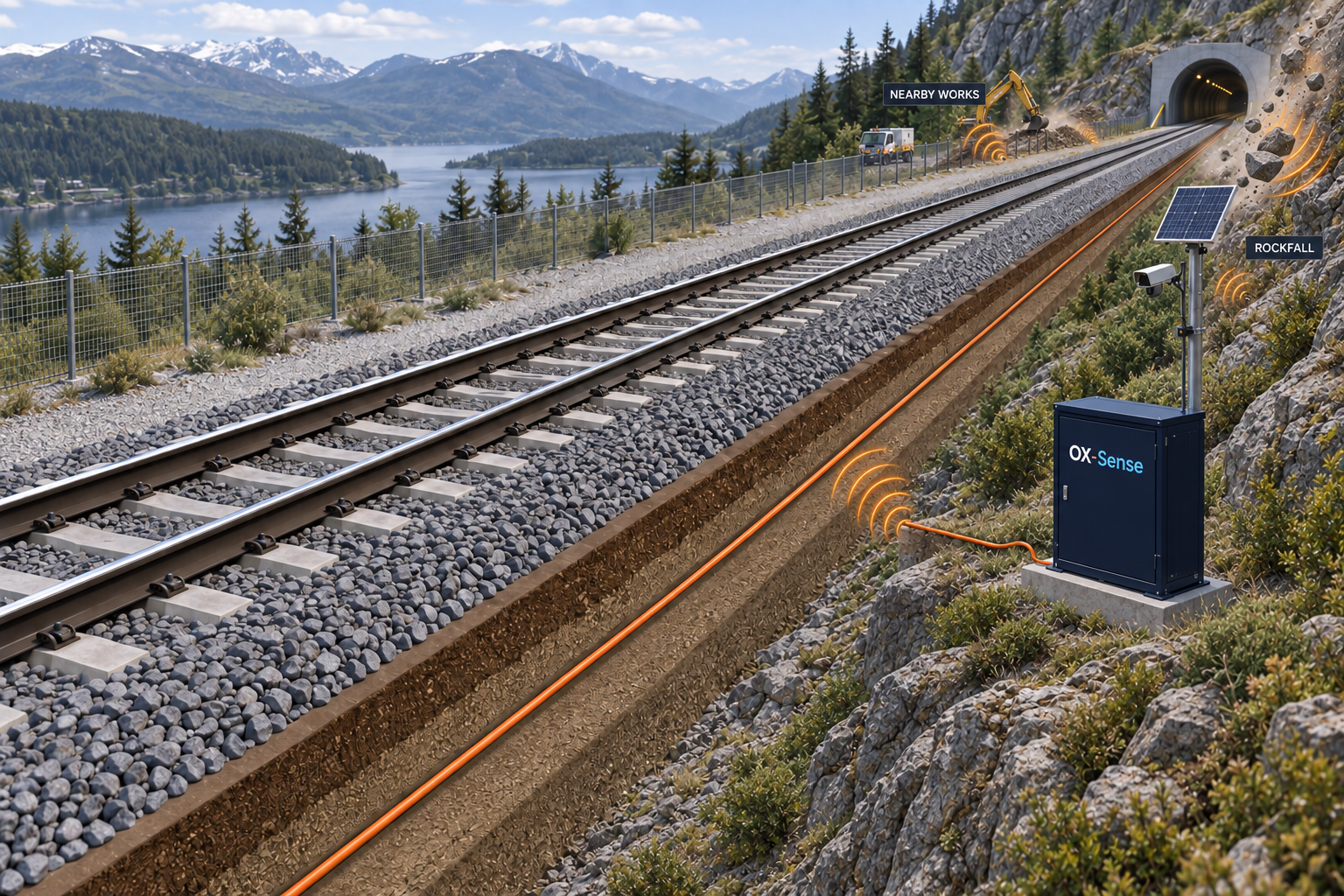
Observe vibration signatures associated with rockfall, slope disturbance, nearby construction and people. Correlate video, inspections and work schedules to investigate location and context.
03 / FROM VIBRATION TO INSIGHT
Acquire spatial and temporal observations from trackside fiber. Incorporate propagation, installation coupling and operating conditions into model development to distinguish moving events from local disturbances.
Assess fiber availability, placement and coupling with track and ground.
Extract moving signatures, repeated impacts and persistent local disturbances.
Combine physical knowledge and field samples to produce traceable analytical evidence.
04 / OPERATIONAL CONTEXT
Connect observations, operating records and field feedback to build understanding of the railway.
Relate fiber distance to railway sections, bridges, tunnels and priority areas.
Use timetables, video and maintenance records to interpret normal work and anomalies.
Retain signals and investigation records for model review and improvement.
05 / FIELD VALIDATION
Pilot against route conditions and target events, defining observation scope, evaluation methods and intended use.
Review fiber separation, depth, troughs and bridge or tunnel conditions.
Include train types, speeds, passing trains and construction noise to assess transfer across sections.
Evaluate location, recognition and false alarms against known events and specialist inspection before expanding.
This solution supports supplementary observation and maintenance investigation. It does not replace train control, interlocking or track circuits; capabilities require field validation.
OX-SENSE / FEEL THE WORLD
Discuss the corridor, fiber conditions and monitoring priorities to define a field validation plan.
Discuss railway monitoring